Technical exercise · complete
Indoor Object Detection
A reproducible YOLO11 baseline with sequence-aware data splitting, evaluation, and visible failure analysis.
Applied ML engineer
Problem and context
Video-derived object-detection datasets make random image splits look stronger than they are because adjacent frames can leak nearly identical scenes across train and validation sets.
My role
I built the public notebook, dataset audit, split logic, training and evaluation flow, and review-ready report.
Constraints
The exercise uses six source video sequences and seven object classes. Validation must stay sequence-disjoint while preserving class support and reproducible review artifacts.
What I built
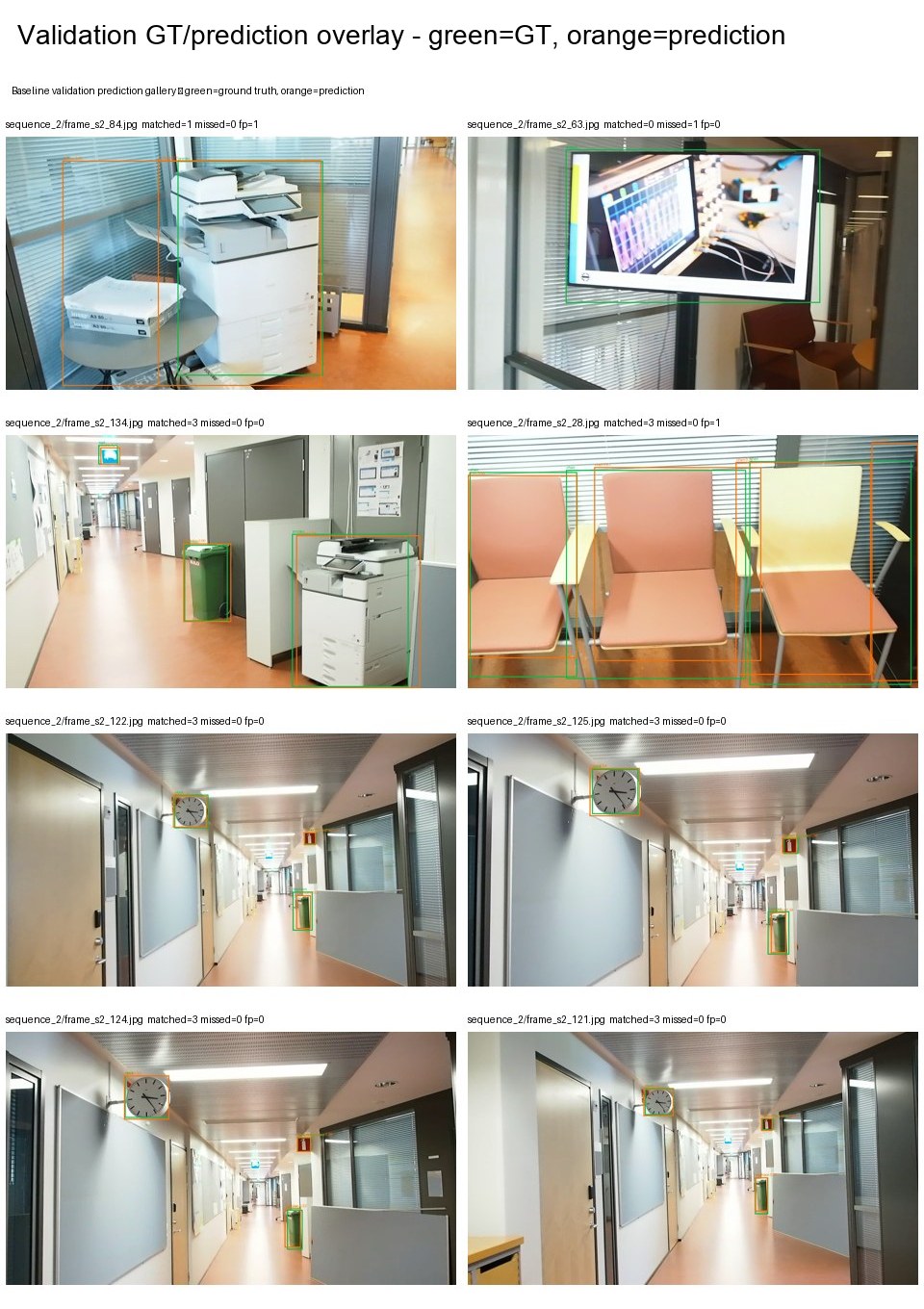
The notebook verifies the dataset, parses annotations, creates a whole-sequence split, trains and evaluates a YOLO11 baseline, and publishes successful and unsuccessful validation examples.
Key decisions
I rejected a superficially attractive chunked split after visual inspection showed semantic leakage, then used a strict sequence-aware split instead.
Evidence
The repository includes the Colab notebook, saved results, asset manifest, evaluation figures, AI-use disclosure, checkpoint release, and dataset attribution.
Results
The work demonstrates the evaluation discipline behind the model: dataset structure, split support, per-class evidence, and visible prediction quality can all be inspected.
Limitations and status
This is a public technical exercise, not employer product work. The published figures describe the accepted exercise run and should be interpreted within that dataset and split.